source: Austin Kocher
Content warning: This post discusses death, medical neglect, and the conditions of immigration detention in some detail.
Fourteen people have died in ICE custody so far in 2026, already more than all of 2024. I’ve been writing about these deaths regularly, and I expect I’ll be writing about more before the year, month, or even week is out. One of the core lessons I’ve learned about the politics of immigration data is that every number does double-duty: every number simultaneously reveals and obscures. So even as I track the number of official deaths, I keep thinking about what the number doesn’t capture. In-custody death counts are the most visible measure we have, but they represent only one part of a broader spectrum of harm that detention inflicts, harm that extends before, during, and after people’s time in custody.
What I want to do here is offer a framework for thinking about this more carefully and with a few added dimensions. This is not intended to be exhaustive; rather, it is intended to serve as a conversation starter, a reminder, a caveat, and a warning to not forget the larger picture. In my reading, there are at least three groups of people who experience serious or deadly harms as a result of detention—yet only one is actually tracked systematically. Understanding all three matters for grasping what detention actually does to people.
The first is people who died in ICE custody, the official count, the one that shows up in ICE’s public reporting. The second group is composed of people who experienced a serious medical emergency during detention and survived, but came close to dying (a much larger and almost entirely uncounted population). The third is people who were released from detention and died afterward, under conditions caused or worsened by their time in custody—equally uncounted. While the first group is the most visible, the two subsequent groups are characterized by their own kind of invisibility. Taken together, they describe a system whose actual toll is almost certainly far higher than any official number suggests.
I’ve been working on this post for a while and eager to finally share this as a contribution to how we think about the harms of detention. Feel free to provide comments, feedback, criticisms, or additional insight that I most assuredly have missed here. Posting these contributions in the comments section helps us bring others into the conversation.
Before going further, I want to flag one report that will come up repeatedly in what follows: Deadly Failures: Preventable Deaths in U.S. Immigration Detention, published in 2024 by the ACLU, Physicians for Human Rights, and American Oversight. It is, to my knowledge, the most comprehensive independent analysis of ICE detention deaths ever produced. Drawing on over 14,500 pages of documents obtained through FOIA litigation, it reviews all 52 deaths reported by ICE between 2017 and 2021, with independent medical expert review of each case. If you care about this issue and haven’t read it, you should. I’ll be drawing on its findings throughout.
Category One: Deaths in ICE Custody are Often Preventable
This is the category that receives attention when it receives any attention at all. ICE is required by law to publicly report in-custody deaths, and I and others like Andrew Free at #DetentionKills (who has been doing this much longer than I have) have been using those reports to track what was, in 2025, the deadliest year for ICE detention in more than two decades: at least 32 people died in ICE custody in 2025, matching a record set in 2004. They died of seizures and heart failure, stroke, respiratory failure, tuberculosis, and suicide. In 2026, the pace has accelerated. As of this writing, 14 people have died in ICE custody since January 1, a rate that has held with remarkably morbid precision at one death approximately every six days. If sustained, that pace would project to over 60 deaths by the end of the year.
I have been writing about each of these deaths as they are reported. Take the following examples.
Emmanuel Damas, a 56-year-old Haitian asylum seeker held at Florence Correctional Center in Arizona, complained of a toothache for nearly two weeks, was given ibuprofen, and was reportedly dismissed by staff who were heard laughing and saying he was faking as he cried for help. He collapsed, developed sepsis from the untreated infection, and died.
Alberto Gutierrez-Reyes, a 48-year-old Mexican national detained at Adelanto after being arrested during intense ICE operations in Echo Park, Los Angeles, reportedly requested medical attention repeatedly and was denied; he died in a California hospital.
Mohammad Nazeer Paktiawal, a 41-year-old veteran of the U.S. war in Afghanistan, was arrested in front of his children and dead less than 24 hours later.
Royer Perez-Jimenez, a 19-year-old Mexican national, was able to commit suicide at Glades County Detention Center in Florida, a facility well known for its systemic failures that the Biden administration shut down and the Trump administration reopened.
Although the Trump administration has tried to dismiss these as outliers or blame the deaths on migrants themselves, they add up to a pattern of effects of what the detention system produces at scale. Systematic research can help us make these patterns clearer.
The Deadly Failures report, which reviewed all 52 deaths reported by ICE between 2017 and 2021, reached a stark conclusion: 95% were preventable or possibly preventable with clinically appropriate medical care. Only three were deemed not preventable. In practice, it seems that medical staff made incorrect or incomplete diagnoses in 88% of cases. Nurses were found texting with their feet up while patients’ health deteriorated. One woman who told staff “she felt like she was dying” (in Spanish) was placed in solitary confinement under suicide watch because the facility couldn’t translate, and staff mistook the statement for suicidal ideation. She died of liver failure days later. ICE allowed detention facilities to destroy video evidence in at least two cases under investigation. In at least two others, detained eyewitnesses were released from custody hours before (and in one case, during) investigator visits.
Rather than investigating the alarming rate of deaths in its custody, this administration has downplayed and ignored them. The press releases ICE publishes to announce these deaths are written in language that shifts blame onto the people who died, framing them primarily through their immigration violations and criminal histories while avoiding any suggestion of institutional responsibility. Adam Sawyer and I recently mapped all 41 detention deaths during the second Trump administration to make these deaths more visible, and one of the things the map shows clearly is a concentration of deaths at a handful of facilities, particularly in South Florida and Southern California, that should have triggered investigations long ago. Death in detention is no longer a shocking rarity. It is becoming a predictable and normalized part of ICE operations while Congress and most of the American public appears unaware or indifferent.
Category Two: Custodial Near-Death Experiences and the Failures That Produce Them
The in-custody death count, even when accurate, tells us nothing about the people who came close to dying but didn’t. This is a much larger population, and we have almost no systematic data on it—but we know that it exists.
What we do know comes from scattered accounts, legal filings, and clinician surveys. The ACLU’s Deadly Failures report includes a striking finding from a 2022 survey of 85 clinicians across the United States: of approximately 1,300 patients those clinicians had seen who had been released from ICE detention, every single one (100%) had experienced adverse health conditions related to their time in detention.
That finding is remarkable not because it is surprising (anyone paying attention to conditions inside ICE facilities would expect widespread health consequences) but because of the completeness. A 100% adverse outcome rate across 1,300 patients is not a pattern with outliers. It suggests that harm is not an aberration within the system but a baseline feature of it.
These include people who survived medical emergencies that, under slightly different circumstances (a slower response, a more understaffed facility, a different shift) would have killed them. The study describes Wilfredo Padron, who survived repeated episodes of radiating chest pain and elevated blood pressure while medical staff failed to conduct an EKG or refer him to a doctor; he then died of a heart attack. For every death the report documents, there are others who had the same symptoms, faced the same failures of care, and survived, not because the system worked but because they got lucky. We don’t know how many, because no one is counting them.
What we can say is that ICE facilities are, on the whole, structurally incapable of providing adequate emergency care for the population they hold. The Deadly Failures report found that in 40% of death cases, facilities failed to provide timely emergency health care or operable emergency equipment. In practice, this means ambulances delayed by over 40 minutes, nurses waiting nearly an hour to call 911 because they lacked authorization from an on-call provider, and emergency equipment that malfunctioned with no backups available. These are not isolated breakdowns. They are features of a system in which private medical contractors (who now operate at over 120 of ICE’s roughly 130 detention facilities) face no meaningful consequences for failure.
As Zain Lakhani of the Women’s Refugee Commission put it in a recent conversation on my Substack, all of our bodies break down, and when they break down inside a facility that is not equipped to provide (or even intended to provide) the kind of comprehensive care that bodies require, the consequences are so much higher. This applies with particular force to populations the system is detaining at increasing rates despite its own policies directing otherwise, including pregnant and postpartum women. Lakhani described one case in which a woman experienced a miscarriage in detention, received no medical oversight for ten days, was deported in an acute medical crisis, and had her life saved only because reception center workers in Honduras rushed her to an emergency room.
There is also the question of mental health, which might be easy to ignore relative to the physical damage that people’s bodies experience, but we need to include it in our analysis. The Deadly Failures report documents cases where people in detention deteriorated psychologically over weeks while staff failed to ensure they received prescribed psychiatric medication; at least one person died by suicide after ICE staff had been explicitly warned about his condition. But many others live through these experiences. The psychological impact of indefinite civil detention (no windows, no clocks, no name tags on guards, no published policies, as the federal judge at Alligator Alcatraz recently documented) does not end when someone walks out the door.
Category Three: Post-Release Deaths, Pre-Death Releases, and the Architecture of Invisibility
Categories One and Two describe harm that occurs inside detention, where it is at least theoretically observable and reportable. Category Three is different. It describes a population whose connection to detention is real but whose suffering takes place outside the institutional boundaries that trigger reporting requirements, investigations, or accountability. Once someone is released, they fall off the system’s ledger entirely.
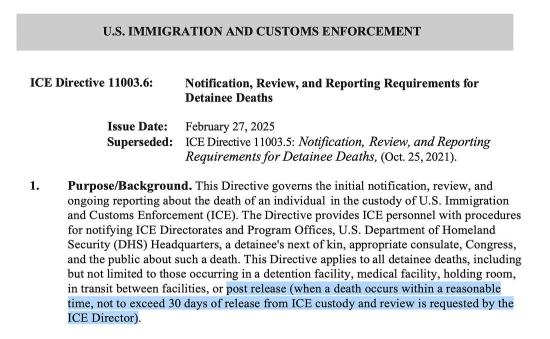
ICE’s own Directive 11003.5 (now revised as 11003.6) provides for the review of deaths occurring “within a reasonable time, not to exceed 30 days of release from ICE custody” when review is requested by the ICE Director. The provision exists precisely because policymakers recognized that the harms of detention extend beyond custody itself. But in practice, the review is discretionary, not mandatory. According to the ACLU’s Deadly Failures report, to the authors’ knowledge, ICE has never ordered a single discretionary review of the death of an immigrant who died after release. The mechanism exists on paper but appears to have never been used.
For people released from ICE detention with untreated or worsened medical conditions, the harms of custody don’t stop at the gate. Chronic conditions interrupted or neglected inside (diabetes, hypertension, cardiac disease, liver failure) continue their trajectory outside, whether that’s in the United States or, increasingly, after deportation.
There is also a more cynical dimension to this category. ICE has a documented practice of releasing critically ill detainees from formal custody while they are still hospitalized, not as an act of compassion but as a bookkeeping maneuver that allows the agency to avoid counting these deaths in its official reports.
According to the ACLU report, between 2019 and 2021 alone, ICE released at least three detained people during hospitalizations prior to their deaths, precisely because counting them would have triggered accountability requirements. During the Obama administration, a New York Times investigation found that the agency had similarly discharged detainees shortly before death, and that one in ten immigration detention deaths had been omitted from a list submitted to Congress.
The named cases of these “pre-death releases” are worth examining in some detail.
Martin Vargas Arellano, a 55-year-old Mexican national detained at Adelanto, was hospitalized at least eleven times during his detention, had his COVID-19 vulnerability ignored when he requested release, suffered a stroke, and was officially “released” by ICE while he lay dying in the hospital. His attorney was not told. She filed a missing persons report, and learned of his death from the coroner’s office, approximately a week after he had died.
Johana Medina Leon, a 25-year-old transgender asylum seeker from El Salvador detained at Otero Processing Center in New Mexico, was found unconscious in her cell and rushed to the hospital. Within hours of her admission, ICE agents arrived at her bedside with parole paperwork. One of them later told investigators he “was not aware of the reasons for the rush” and had never before served release documents at a hospital. She was recorded as “no longer in ICE custody” twenty minutes after her condition was described as “serious/critical.” She died four days later, never having left the hospital. Her death does not appear in ICE’s official 2019 in-custody statistics.
These cases sit at the boundary between Category One and Category Three. The people were dying in hospitals; ICE manufactured their reclassification as “released” specifically to keep them off the official count. The practice of pre-death release is, in this sense, the mechanism by which the system actively produces the invisibility that defines Category Three, converting what would otherwise be a counted death into an uncounted one through a procedural act that changes nothing about the medical reality.
It is worth noting that the structural conditions driving post-release harm have worsened considerably. A March 2026 analysis by KFF found that 32 of the 46 deaths reported by ICE between January 2025 and March 2026 were people with pre-existing medical conditions who experienced worsening health complications in custody. ICE tries to avoid responsibility by blaming the pre-existing conditions part, but the truth is, people are still dying in detention from preventable things they likely wouldn’t be dying from elsewhere.
More troubling still is the fact that ICE’s payments to the contractors providing medical care at its facilities lapsed after the VA terminated a longstanding claims processing agreement in October 2025. In other words, the people being released into the community right now are sicker than those released before, and the care infrastructure that was supposed to treat them inside was already falling apart before the payments stopped.
Predictable Death, Structured Impunity
To be clear about what I am and am not arguing: I am not claiming that the Trump administration, or any administration, has a policy of intentionally killing detained immigrants. The ACLU report is careful about this distinction, and so am I. In fact, in an interview with Kara Swisher recently, she asked me about whether I consider these detention centers “concentration camps.” I give a more thorough answer than I’ll get into here, so please give it a listen.
What the evidence does support is that the system is structured to make death and serious harm predictable outcomes, while simultaneously structured to avoid accountability for those outcomes. Medical contractors face no meaningful penalties, facilities fail inspections that carry no consequences, evidence is destroyed, witnesses are released, and people are discharged from custody on their deathbeds so their deaths don’t appear in the official count. The system produces both the harm and the mechanisms for obscuring it.
There is a useful concept from systems thinking that applies here: POSIWID, or “the purpose of a system is what it does,” a heuristic developed by the organizational theorist Stafford Beer. The idea is that we should resist reading a system’s purpose from the intentions of those who operate it, and instead look at what the system actually and consistently produces. Applied here, the question is not what ICE says its detention system is for (public safety, immigration enforcement, orderly removal) but what it reliably does, which is expose a captive population to predictable health risks, insulate contractors from accountability, and generate records that are difficult to obtain and easy to destroy. That is the system functioning as designed, not failing.
This is what scholars mean when they talk about the administrative production of death—not a bullet or a deliberate act, but a sustained arrangement of institutions, contracts, and procedural choices that together make death a statistically predictable result, and that ensure, by design, that no one is held responsible for it. Researchers who study bureaucratic violence define it similarly: as harm administered not through overt force but through “processes of decision-making, paperwork, knowledge production, inaction, and exclusion,” in the words of E.R. Eldridge and A.J. Reinke, who discuss the concept in a 2018 essay in Conflict and Society. The distinction is important because it tells us where to look for accountability. If the violence is bureaucratic, the responsibility is distributed across a system in ways that make it very difficult to locate in any single actor or decision. I’ve described this elsewhere as the precarious life of the migrant: a politically induced condition of maximized risk in which being exposed to death is, for many people, simply part of what it means to be a migrant.
Geographers Geoffrey Boyce and Samuel Chambers have documented how the U.S. government deliberately funnels migrants into remote desert terrain, making the crossing itself more dangerous, as a strategy of deterrence. I’ve written before about how this policy of “prevention through deterrence” produces migrant death at the border as a predictable, structural outcome rather than an aberration. The architecture of suffering is designed to discourage people from attempting entry in the first place. Their argument is specific to the border. But it points toward a logic that I think operates, in a modified form, inside detention as well, not as deterrence against entry but rather as coercion directed at people who are already here. Inside ICE facilities, suffering functions as pressure to accept “voluntary” departure rather than endure indefinite detention, and as a kind of punishment for those who refuse to leave.
For example, a CNN review of internal DHS documents found that of the roughly 72,000 people who have self-deported through the administration’s Project Homecoming program, more than half (37,281) were in ICE detention at the time they signed up. As one immigration attorney told CNN, detained people are “having to choose between a prolonged detention and spending a lot of money to fight their case, or take voluntary departure.” This type of coercion is structural. The administrative production of suffering serves institutional and political ends, whether at the border, as Boyce and Chambers argue, or behind the walls of a detention center. The goal is not death, but compliance. Death is what happens when compliance-through-suffering operates without adequate medical infrastructure, oversight, or accountability—which, as the evidence above suggests, it routinely does.
What connects the border, the detention facility, and the space after release is that each site produces death through a combination of policy choices and institutional neglect, and that the further you move along that continuum, the harder the deaths are to see and the less likely anyone is to come looking.
In this frame, the in-custody death count is not the sole measure of the detention system’s violence—even if it is its most visible symptom. The actual scope of harm extends outward from the facility in ways that are, by design, difficult to see: into hospital rooms where people are “released” while dying, into communities where people carry untreated conditions that no one tracks, into a reporting architecture that counts only what it is forced to count and nothing more. What we are looking at, when we look at the official numbers, is not the full picture but the portion of the picture that the system has failed to conceal (and would happily conceal if it could).
This distinction is crucial because the deaths that don’t appear in official data might actually be more revealing of how the system truly works than the ones that do.
P.S. Just as I was finishing this post, Eyes On Ice published an important analysis of the death of Nurul Amin Shah, the blind man who died after being released from ICE custody a few weeks ago. The Erie County Medical Examiner has now ruled his death a homicide, a determination that lands with particular force given everything I've described above. Shah Alam, a 56-year-old nearly blind Rohingya refugee who had fled genocide in Myanmar, was left by Border Patrol agents outside a closed Tim Hortons in Buffalo at 8:18 PM in freezing temperatures, without shoes, without notification to his family or attorney. He wandered more than six miles before his body was found five days later. The medical examiner found he died of complications from a perforated duodenal ulcer, worsened by hypothermia and dehydration. DHS publicly insisted he showed no signs of distress or disability at the time of release, but his documented conditions complicate the official narrative. Shah Alam's case exemplifies exactly what I’ve described as the detention system producing death through a chain of procedural decisions, then denying responsibility.
Thursday, April 2, 2026