source: Jiggy Geronimo Substack
We know something about how to take down authoritarianism. It doesn’t usually fall from a single dramatic confrontation at the top. It falls when you systematically remove the pillars that hold it up — the institutional support, the technical infrastructure, the local compliance, the perception of inevitability. Pillar theory tells us that the strategic goal is to make the regime incapable of functioning — to raise the cost of operating it, to create gaps in its machinery, to withdraw the cooperation it depends on at every level.
The way we bring down these pillars is the sustained defiance of a coordinated and effective movement. The organizing infrastructure that makes movements durable gets built locally. Neighbors build it when they connect around a concrete fight, win something tangible, and stay connected afterward. Minneapolis didn’t come from nowhere. It came from years of rooted community organizing that created the trust, the relationships, and the collective capacity to act when a moment arrived.
We can apply and leverage both of these insights right now – to the local fights against the fascist surveillance state.
The Architecture of the Surveillance State Is Local
The infrastructure that makes mass deportation, mass surveillance, and authoritarian policing possible is not primarily federal. Much of it lives in city council chambers— and that means it’s vulnerable in ways that federal power isn’t.
The pipeline works like this:
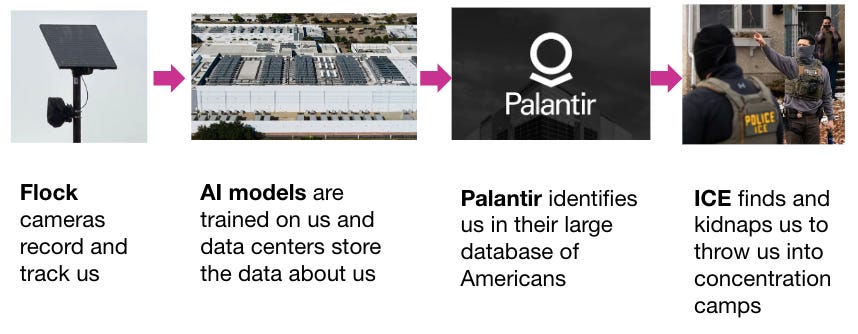
This machinery is working to kidnap immigrants right now, but will rapidly be turned toward anyone that dissents soon enough if we don’t start working to dismantle it, and local fights are how we do that.
Every link in that chain has a local contract. Every local contract is a point of leverage.
Flock Safety has deployed over 100,000 cameras across the US, marketed to local police departments as license plate readers — but these cameras are more like surveillance cameras that also happen to read license plates. They can detect human characteristics and identify things like hair color, gender, height, etc. Recent updates to Flock cameras include a feature called Raven which captures audio – it’s marketed as “gunshot detection” but it can listen to conversations. Their data flows easily to federal agencies and is actively being used to assault and abduct our immigrant neighbors and tracking people seeking abortion care. Cities signed these contracts. Cities can terminate them. In fact, 82 cities already have.
Palantir contracts with municipalities for policing, health administration, and data integration — while simultaneously holding a massive federal contract with ICE, providing what they call ImmigrationOS to support deportations. They’ve been contracted by the Trump administration to build a “master database“ consolidating personal information on Americans from the IRS, DHS, SSA, and other agencies. The New York Health system just voted not to renew their Palantir contract. That happened because people organized and made it politically costly to stay in.
AI data centers — the physical infrastructure storing surveillance data and training the models powering it — are being proposed and built in communities across the country. 71% of Americans oppose data centers near them. They drive up energy prices and threaten clean drinking water. This is one of the rare issues that actually cuts across red and blue communities alike! Due to public pushback, nearly half of the planned data centers have been paused or cancelled. The largest proposed data center in the world was just cancelled in Virginia and Kevin O’Leary has had to shrink his data center project by 50% due to attention and backlash.
Organizing against ICE concentration camps follows the same logic. Many ICE “warehouses“ — the facilities where people are held before removal — are not federal buildings. They are privately contracted facilities, and those contracts often run through local and state governments or private prison companies operating with local approval. Communities have successfully fought to block or close these facilities by pressuring local officials, challenging zoning, permitting, and environmental review, and making the political cost of hosting them too high. In fact, more than half of the newly proposed warehouses have been paused.
Every camera taken down, contract cancelled, or facility that doesn’t get built is capacity removed from the fascist deportation machine. And all of these campaigns build exactly the kind of broad, multiracial coalitions — immigrants rights groups, faith communities, housing advocates, neighbors — that become the foundation of durable local organizing power.
Dismantling fascism one contract at a time
When a city council votes to terminate a Flock contract, the fascist machine becomes less efficient. The surveillance network develops gaps and the feedback loop of data harvesting gets interrupted.
When a community blocks an AI data center, they’re doing more than protecting their water supply. They’re raising the cost and slowing the infrastructure that makes mass surveillance scalable.
These are more than symbolic wins. These are structural wins. The surveillance state is constructed — contract by contract, camera by camera, data center by data center. If we break enough pieces of the machinery, the machinery can’t work effectively. Dismantling this fascist machinery is crucial to helping our authoritarian systems actually fall.
The Organic Energy Is Already There
As organizers, we often ask “how can we activate people?” but all we need to do is open our eyes and ask ourselves a different question: what is already activating people?
There is enormous organic energy for these fights already on the ground. People are scared, they’re angry, and they want to do something that actually matters. People are fatigued with petition signing and screaming into the void of national advocacy with no tangible change.
So it makes perfect sense that they’ve turned to the things that they can see and feel and control locally. People see these cameras every day as they’re walking around their communities. People hear the horrible hum of data centers. People see the warehouses that might soon be holding human beings in cages. They see these things in their environment and they’re being driven to do something about it.
Importantly, these fights are winnable. A city council vote has a date. It has five names on it. You can show up. You can win. And from that win, you can build relationships in a community to continue organizing.
I can attest to this from personal experience. In the town where I live, there was no real existing organizing infrastructure until a bunch of neighbors started talking to each other about the Flock cameras around town. We learned that the Flock contract was up for renewal, started a Signal chat, and started meeting with our city council members. We organized through local FB groups, Next Door, and WhatsApp moms groups to gather 300 signatures on a letter to city council and turned out dozens of people for public comment. At 12:45 in the morning, after hours of testimony, the city council voted 3-2 to terminate the contract. They told us the city council had never received so much public engagement on any issue ever. They had no choice but to listen.
And here’s the part that matters most for the long game: my neighbors are now connected to each other. They’re organizing mutual aid and coordinating protest attendance and figuring out how to find someone to run against our mayor. They built an organizing infrastructure that didn’t exist before. The win on the contract was real — and it became the on-ramp to something more durable and lasting
That’s the model. Not just the contract termination, but the community that gets built in the process of fighting for it. If we learned one thing from Minneapolis, it is that we need to start organizing with our neighbors. These fights are winnable, they’re strategic, and they create exactly the kind of rooted local infrastructure that makes movements capable of doing more over time.
What This Requires From Our Movement
Our movement needs to treat these local fights as the strategic priority they are — not a side track to national work, but the terrain where some of the most important work is happening.
That means:
- working with and supporting the work of the groups that are already meeting this moment like DeFlock, EFF, Purge Palantir, and Project SaltBox.
- organizations that have local chapters or grassroots activists should lean into these fights by resourcing research and rapid response capacity so local groups can quickly understand what contracts exist in their jurisdiction and when renewal decisions are coming
- providing legal and technical support so communities can analyze what they’ve actually agreed to in their contracts
- building these fights into a key part of our narrative, highlighting these local wins and lifting this strategy up as key to our fight against fascism
- building coordination across localities so that when Santa Cruz wins, San Jose knows about it immediately and can adapt the model
- investing in the direct organizing capacity — the time, the relationships, the presence at public meetings — that makes these fights possible
The fights are already happening. The energy is already there. What’s needed is the resourcing and attention to make those fights faster, better-connected, and more replicable — so that every win becomes a template and every organized community becomes a node in something larger.
The fascist machinery is not inevitable. It is constructed, and it can be dismantled the same way — piece by piece, contract by contract, community by community. This is how authoritarianism falls. And this is a strategic fight that our movement should take on at scale.
